

Yu-Gi-Oh at 25: Why the Market Is Finally Starting to Look Like Pokémon and Magic
Yu-Gi-Oh at 25: Why the Market Is Finally Starting to Look Like Pokémon and Magic
When people talk about collectible card games, the conversation almost always starts with Magic: The Gathering or Pokémon.
For years, Yu-Gi-Oh lived in a strange middle ground.
It was wildly popular, but collectors didn’t always treat it the same way. Cards were played hard. Condition often didn’t matter. Grading wasn’t common. And a lot of early cards that should have been preserved simply weren’t.
But something interesting has been happening over the last few years.
As Yu-Gi-Oh celebrates its 25th anniversary, the market is slowly maturing — and it’s starting to behave more like the long-established collectible ecosystems around Magic and Pokémon.
If you’re a collector, creator, or someone building a trading-card-focused brand, this shift is worth paying attention to.
The 25-Year Milestone Changes How People Think About the Cards
Twenty-five years is an important psychological milestone in collectibles.
You see this pattern repeatedly.
When a franchise crosses that threshold, the conversation shifts from game pieces to historical artifacts.
Magic went through this.
Pokémon went through this.
Now Yu-Gi-Oh is beginning the same transformation.
Early sets like:
-
Legend of Blue Eyes White Dragon
-
Metal Raiders
-
Spell Ruler
-
Pharaoh’s Servant
are no longer just nostalgic — they’re part of the game’s early history.
And when collectors start viewing something as history rather than just nostalgia, preservation becomes important.
That’s where grading, storage, and display begin to matter much more.
The Grading Culture Is Catching Up
For a long time, graded Yu-Gi-Oh cards were relatively rare compared to Pokémon or Magic.
That’s changing quickly.
Collectors are now sending cards to:
-
PSA
-
BGS
-
ARS
-
CGC
The reason is simple.
People are realizing something that longtime Magic collectors already understand:
A card in mint condition today may become extremely difficult to find in that condition later.
________________________________________________________________________________________________
Why High-Grade Yu-Gi-Oh Cards Are So Much Rarer
One thing newer collectors often miss is that Yu-Gi-Oh print quality has never been particularly forgiving, especially compared with Pokémon.
Early 2000s Konami cards — particularly from the original North American sets — were printed on relatively soft cardstock and were extremely prone to edge wear and surface scratching. Even fresh out of the pack you could see:
-
minor whitening on corners
-
print lines across holographic foils
-
factory scratches
-
severely off-center cuts
Anyone who opened packs back then remembers this. You could pull a holographic card, sleeve it immediately, and it would still show small imperfections under light.
Because of that, true gem-mint examples are far rarer than people assume.
Now compare that to Pokémon.
Pokémon cards historically came off the press with very consistent print quality. The cardstock is thicker, the foiling process tends to hide surface imperfections better, and centering is usually tighter. As a result, high-grade Pokémon cards are much easier to achieve in PSA 10 condition.
Yu-Gi-Oh doesn’t behave the same way.
When you start digging through grading populations, you see something surprising:
some Yu-Gi-Oh cards have extremely small PSA populations.
There are cards from early sets where:
-
total PSA populations are in the double digits
-
PSA 10 examples might only number a handful of copies
-
even PSA 9 populations remain surprisingly small
To illustrate this point, lets take a look at an iconic spell card: Tribute To The Doomed
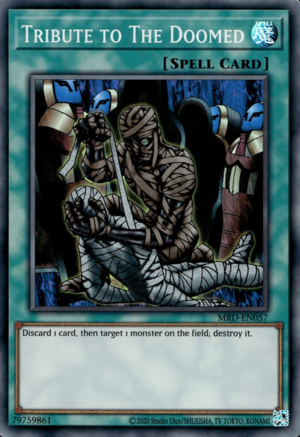
For the unlimited release of the MRD version we have a total of 70 graded copies with only 15 reaching a PSA 10! Incredible! And to think only 26 PSA 9s exist is crazy as well.
| Auth | 1 | 1.5 | 2 | 3 | 4 | 5 | 6 | 7 | 8 | 9 | 10 | Total |
|---|
|
|
0
–
0
|
–
0
0
|
0
0
0
|
3
0
0
|
3
0
0
|
4
0
0
|
5
0
0
|
7
0
0
|
7
0
0
|
26
–
0
|
15
–
–
|
70
|
Meanwhile, comparable Pokémon cards from the same era might have hundreds or even thousands of graded examples.
This isn’t necessarily because Yu-Gi-Oh was less popular — far from it.
It’s because for most of the early years:
-
People played their cards heavily
-
Few collectors thought to grade them
-
And the print quality itself made perfect copies difficult to obtain
That combination creates a very interesting situation today.
When pristine Yu-Gi-Oh cards do appear, they’re often much rarer than collectors initially realize.
And as grading culture continues to grow around the game — something that’s clearly accelerating during the 25th anniversary era — we may start to see the market recognize just how scarce true high-grade examples really are.
Why Display Matters More Than Ever
As cards transition from gameplay objects to collectible artifacts, presentation starts to matter.
A raw card in a sleeve is fine for storage.
But collectors increasingly want ways to display cards as objects of interest.
This is something that has already happened in other collectible markets:
-
Sports cards
-
Magic: The Gathering
-
Pokémon
-
Comic books
-
Coins
Once collectors start thinking of something as a collectible rather than a tool, they want to see it, display it, and share it.
That’s exactly why I began designing custom card display pieces in the first place.
Custom Display Pieces for Yu-Gi-Oh Collectors
One thing I noticed early on is that most trading card storage products are designed purely for protection.
They’re not designed to actually showcase the card.
That’s where custom display pieces come in.
For collectors who want something more interesting than a plastic stand, I started building custom pieces that combine display, protection, and presentation.
A few examples from the shop:
Yu-Gi-Oh Artifact Display Stands
Designed to turn a single card into a desk artifact rather than something hidden in a box.
👉 https://geniusloci.app/products/yugioh-artifact-display-stand
Toploader Protection Cases
Perfect for cards you want to protect or ship.
👉 https://geniusloci.app/products/trading-card-display-pedestal
The idea behind these designs is simple:
Treat the card like a museum object, not just a game piece.
The Rise of “Card Artifacts”
One of the things I think we’ll see more of over the next decade is the idea of card artifacts.
Instead of selling cards alone, collectors are starting to think about presentation and story.
This can mean:
-
Cards paired with custom display pieces
-
Graded slabs mounted in framed displays
-
Themed collections presented together
-
Cards treated like historical objects
In other collectible markets, this approach already exists.
Coin collectors have display cases.
Comic collectors have slab frames.
Sports cards have museum-style displays.
Trading cards are simply catching up.
What Collectors Should Pay Attention to Right Now
If you're collecting Yu-Gi-Oh today, a few things are worth watching.
1. Early print cards in high condition
Many early cards were heavily played. Mint copies will always command attention.
2. Unique rarity tiers
Modern sets are introducing rarity types that weren’t present in early Yu-Gi-Oh.
Things like:
-
Quarter Century Rare
-
Starlight Rare
-
Collector Rare
These could become long-term collectible tiers the same way certain Pokémon and Magic printings did.
3. Preservation
Even basic protection and proper storage can dramatically affect long-term value.
Collectors who think about condition today are often rewarded later.
A New Era for the Game
Yu-Gi-Oh isn’t just a card game anymore.
It’s entering the same long-term collectible space occupied by Pokémon and Magic.
That means we’ll likely see:
-
More grading
-
More preservation
-
More display culture
-
More historical appreciation of early sets
For collectors and creators alike, that shift opens up a lot of interesting possibilities.
And honestly, it makes the hobby more fun.
Believe in the heart of the cards! Talk to you later creator, thanks for reading!